
The hospitality industry thrives on people, but the reality is that not all hotel jobs are created equal when it comes to safety. While the lobby is buzzing, many dedicated employees—housekeepers, room service staff, and maintenance crews—are working alone in isolated areas like guest rooms, service tunnels, and quiet corners of the property. This isolation creates a unique and serious safety vulnerability.

The Illinois Safety Act
For hotel owners and IT directors in Illinois, the need for a reliable safety system became a legal mandate with the passage of the "Hotel and Casino Employee Safety Act." This law requires hotels to provide every employee with a functional, reliable, and discreet panic button. It’s a huge win for worker peace of mind, but it gave property managers and tech teams a crucial assignment—how do you ensure that button works, every time, in every single room of a large, multi-story building, and how do you make sense of the location data to enable a real-time response?
The answer wasn't simple, especially given the thick concrete and expansive layouts of these properties. Compliance means providing a genuine lifeline, not just checking a box.
The Infrastructure Gap
When we began working with clients on these projects in Illinois, the first question we addressed was naturally—why not just use the existing Wi-Fi network?
The simple, practical reason is that Wi-Fi is terrible for mission-critical, life-safety coverage across a large hotel:
- Wi-Fi Killers: Wi-Fi signals struggle to penetrate the structural materials found in hotel bathrooms, utility closets, and service elevators, creating "dead spots" exactly where an employee might need help most.
- The Battery Headache: Devices constantly searching for a Wi-Fi signal are power-hungry. Managing a fleet of devices that need frequent charging or battery changes is a huge operational burden and a major point of failure.
- Lack of Precision: Wi-Fi can tell you which floor you're on, but locating an employee to a specific Room 305 in seconds? That requires more specialized tech.
The Hybrid Approach
To solve this, we deployed a smart hybrid solution leveraging two IoT standards—LoRaWAN® for connectivity and BLE for hyper-local positioning.
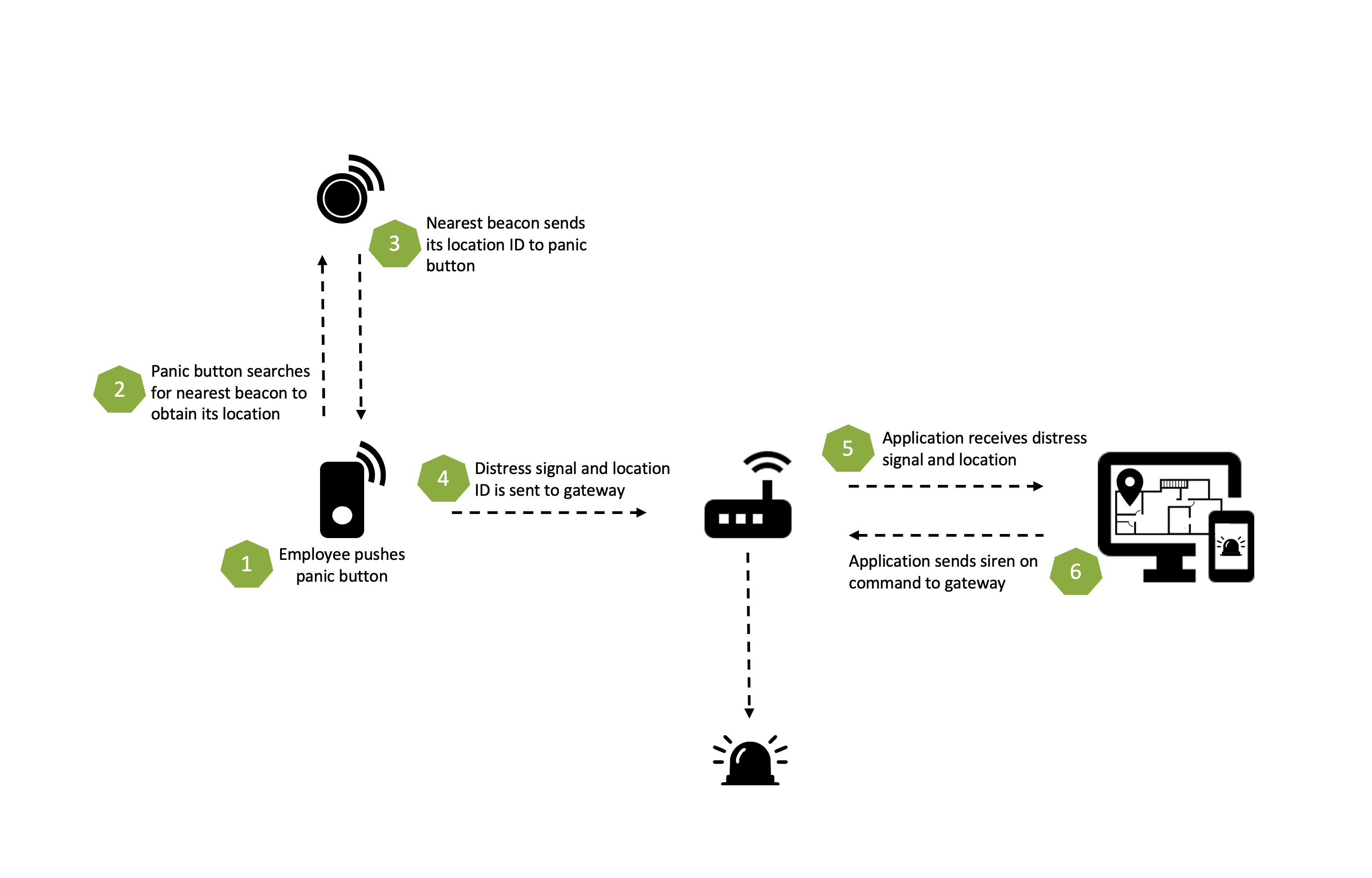
Here’s how our solution delivered guaranteed, floor-by-floor coverage in the Illinois hotels:
- The Connectivity Hero: We installed just one LoRaWAN® Gateway per hotel, centrally located in the manager's office on the ground floor. This single gateway was capable of providing robust coverage across all floors of the property, proving the powerful penetration of LoRaWAN® technology.
- The Location Detectives: In every single guest room (and common area like fitness and conference rooms), we discreetly placed a small BLE beacon (under the bathroom sink, for example). Each of these beacons has a unique digital ID (its MAC address).
- The Employee Device: The employee carries a small LoRaWAN® device with a built-in panic button. This device is smart—it's constantly listening to measure the signal strength of the closest BLE beacons.
When the panic button is pressed, the device immediately broadcasts the signal strength and unique ID of the closest beacon using the robust LoRaWAN® network. This simple data packet is the key to knowing the employee’s exact location.
From Button Press to Real-Time Response
The real challenge isn't just getting the signal out; it's translating that raw beacon data into an immediate, actionable location for security personnel. This is where the importance of data processing and data analysis comes into play, providing real-time insights, alerts, and notifications to ensure an immediate, coordinated response.
- The LoRaWAN® Network Server: The signal is received by the LoRaWAN® Gateway and forwarded to a LoRaWAN® Network Server (LNS).
- The Analytics Platform: The LNS routes the data to the analytics platform. Here’s where the magic of location translation happens: The analytics platform instantaneously processes the raw signal strength data, uses the unique BLE beacon MAC address (which has been assigned a specific room number), and maps it to a plain-language location (e.g., "Room 305" or "2nd Floor Conference Room").
- The Local Alarm: The analytics platform then immediately sends a downlink command back through the LoRaWAN® network to a LoRaWAN® Siren installed in the manager’s office on the bottom floor. The siren activates, blaring an alert that signals a serious, confirmed incident is in progress.
- Digital Dispatch: Simultaneously, the analytics platform provides visual alerts and push notifications with the precise room number and time stamp to the designated response team via the web and mobile applications on their phones.
This combination of the physical siren and the digital alerts allowed the hotel’s response team to quickly and confidently locate the employee who triggered the panic button. It’s an enterprise-grade safety system that moves beyond simple compliance to deliver true, dependable peace of mind.

Turning Liability into Profit
The true measure of this deployment's success goes beyond the button press; it’s the instant de-risking of our client's entire business. Before this solution, the hotel faced a gaping hole of liability exposed by the state mandate. Now, that exposure is sealed shut, turning a mandatory cost into a competitive financial advantage.
By proactively ensuring compliance with the Hotel and Casino Employee Safety Act, our deployment has eliminated the threat of potentially devastating financial impacts for our clients.
Consider the alternatives to compliance:
- Direct Statutory Fines: The law allows for damages up to $350 per violation, and critically, each day a violation continues is a separate violation. For a large hotel, non-compliance can quickly escalate into a multi-million dollar liability in direct fines alone.
- Catastrophic Lawsuits: Failing to provide an employee with a functional safety device exposes the business to settlements and legal claims that often range from $500,000 to over $2,000,000 per incident.
- Brand Damage and Attrition: The reputational cost of an incident in a non-compliant environment is irreparable, leading to lost business and higher employee turnover, which increases operational costs dramatically.
The cost of this robust, full-coverage IoT solution is dwarfed by the single-day penalty of non-compliance. For hotel owners, this is not a cost; it is the smartest insurance policy for their people and their P&L.
A Guaranteed Return on Safety!
The results for our clients were not just technical—they were transformational.
We didn't just install a safety system; we installed peace of mind, translating directly into a monumental return on investment (ROI). Our clients' employees now move through their shifts with confidence, knowing a dedicated response team is a single, instant touch away.
For hotel owners, this investment isn't just a cost of doing business; it's the smartest business decision of the decade.
The fixed, predictable cost of our solution secures the hotel's business by avoiding infinite liability, dramatically improving employee retention, and securing their brand reputation as a champion of safety.
We close this chapter for our clients, who are now not just compliant, but champions of safety, securing their employees, their reputation, and their bottom line. Game on!
Explore our Emergency Response SOS Solution
This solution is built on our Ginjer and Netsy platforms. Learn more about how it can be applied to large-scale hotels, resorts, and corporate campuses.